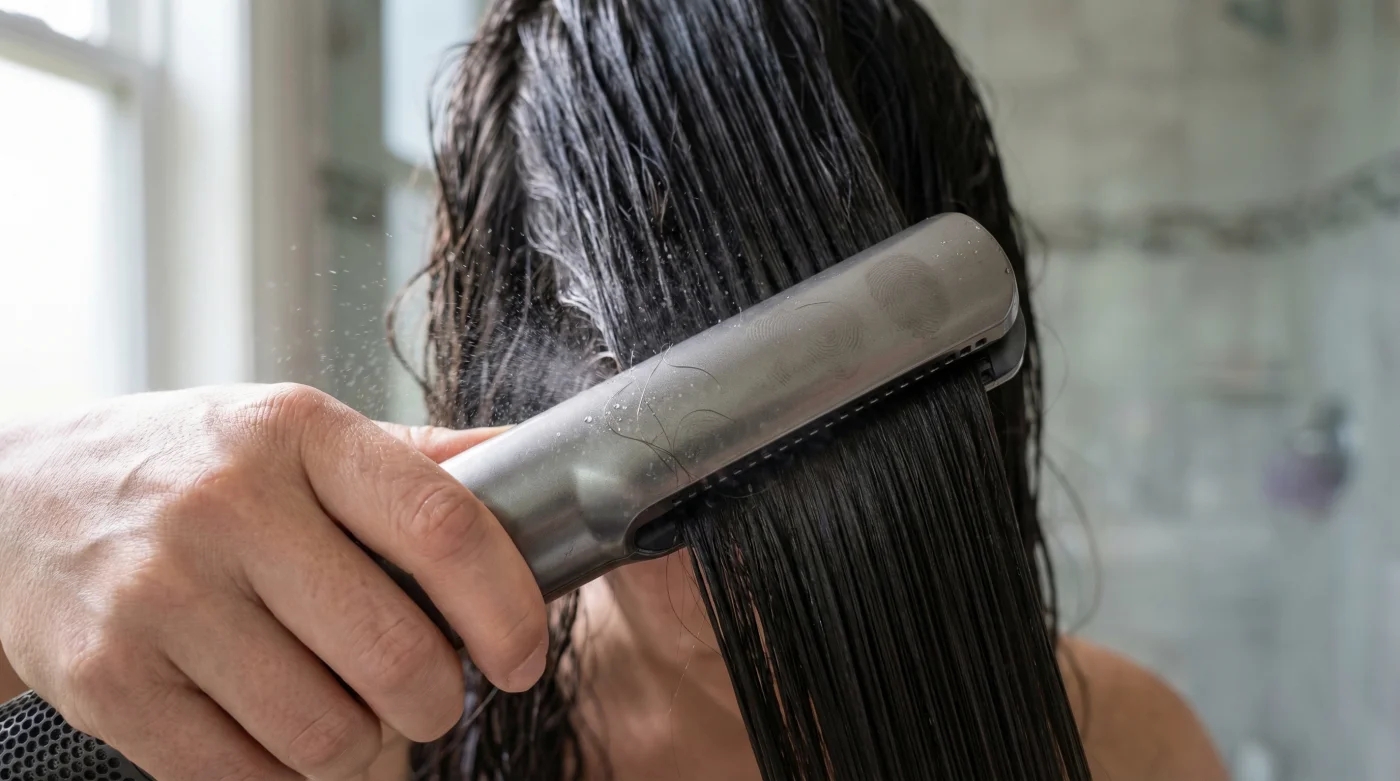
For decades, the pursuit of perfectly straight, glass-like hair has demanded a heavy sacrificial offering: the structural integrity of the hair shaft itself. Millions of Americans start their morning routine with the distinct, unsettling sizzle of residual moisture boiling against ceramic plates—a phenomenon known scientifically as ‘bubble hair,’ where rapid water expansion fractures the cortex. We have accepted thermal damage as the unavoidable tax for a polished aesthetic, cycling through protectants and treatments in a desperate attempt to mitigate the breakage.
However, a paradigm shift in beauty engineering is currently disrupting this cycle, effectively rendering the concept of ‘hot plates’ obsolete for straightening. By harnessing high-velocity aerodynamics rather than extreme thermal conduction, a new technology is allowing users to go from completely wet to styled straight without a single heating element crushing the cuticle. The result is not just a style change, but a preservation of hair strength and shine that was previously impossible with traditional irons.
The Aerodynamic Architecture: How Air Replaces Iron
The core innovation of the Dyson Airstrait lies in its rejection of the standard ‘clamp and cook’ method. Instead, it utilizes a precise manipulation of airflow to create tension. Two 1.5mm apertures accelerate airflow to high speeds, creating two high-velocity downward blades of air. Projected at a 45-degree angle, these blades converge to form one focused jet of force that creates the downward force to straighten hair as it dries, while simultaneously aligning the hair strands.
This mechanism relies on the preservation of hydrogen bonds. When hair is wet, these bonds are naturally weakened and reset. By styling from a wet state with supported airflow, the Dyson Airstrait sets the bonds in a straight configuration without requiring the extreme temperatures needed to alter dry hair bonds. This is a fundamental application of fluid dynamics over thermal conduction.
Comparison: Thermal Plates vs. Air Pressure
| Feature | Traditional Flat Iron | Dyson Airstrait™ |
|---|---|---|
| Heat Source | Direct contact ceramic/tourmaline plates | High-pressure directional airflow |
| Maximum Temperature | Up to 450°F (Critical damage threshold) | Max 285°F (Controlled sensors) |
| Wet Hair Capability | Dangerous (Causes boiling/breakage) | Native (Simultaneous drying/styling) |
| Structural Impact | Compresses and flattens cortex | Maintains natural volume and body |
| Target Audience | Thick, coarse hair requiring high heat | All hair types focusing on health/shine |
- Shark Beauty dominates the hair tool market with aggressive price points
- COSRX snail mucin repairs moisture barriers faster than hyaluronic acid
- UV gel lamps damage skin DNA without protective fingerless gloves
- Rosemary oil stimulates hair regrowth as effectively as minoxidil concentrations
- Ozempic users report rapid facial aging that fillers cannot easily fix
Under the Hood: The Hyperdymium™ Specification
The efficacy of the Dyson Airstrait is powered by the Hyperdymium™ motor, a technological marvel that spins at up to 106,000 revolutions per minute. This is not merely a fan; it is an internal propulsion system capable of propelling 11.9 liters of air through the machine per second. This generates up to 3.5kPa of air pressure, which is the ‘dosage’ required to straighten hair as it dries without mechanical crushing.
Furthermore, intelligent heat control is paramount. Glass bead thermistors measure the airflow temperature 16 times per second (thermometrics) to prevent heat damage and protect the hair’s natural shine. This data is sent to a microprocessor which regulates the heating element, ensuring temperature never exceeds the selected setting.
Scientific Data & Temperature Dosing
| Parameter | Technical Spec / Dosing | Scientific Mechanism |
|---|---|---|
| Motor Speed | 106,000 RPM | Generates 3.5kPa pressure for tension |
| Airflow Angle | 45 Degrees | Converging blades align cuticle downward |
| Wet Mode Temps | 175°F, 230°F, 285°F | Gradual moisture removal without boiling |
| Dry Mode Temps | 250°F, 285°F, Boost | Refreshes style by resetting dry bonds |
| Negative Ions | Emitted at output | Reduces static and electricity in styling |
With the engineering metrics established, success depends entirely on executing the correct ‘wet-to-dry’ protocol to maximize longevity and finish.
The Styling Protocol: Usage and Troubleshooting
Transitioning to the Dyson Airstrait requires unlearning the habits of traditional flat ironing. You do not need to wait for hair to be bone dry; in fact, the device requires moisture to function optimally in its primary mode. The recommended routine involves rough-drying the roots with the arms of the device locked shut, then releasing the lock to pass sections of hair through the airflow blades.
For optimal results, ‘dosing’ your speed is critical. A slower pass allows the airflow to fully dry the section and align the cuticle. Rushing the pass may leave residual moisture in the cortex, leading to reversion (frizz) later in the day.
The Progression Plan: What to Look For
| Styling Phase | Technique / Setting | Quality Indicator (What to Look For) |
|---|---|---|
| Phase 1: Root Lift | Locked Arms / High Air / 285°F | Roots are 80% dry before sectioning begins. |
| Phase 2: Wet Styling | Wet Mode / Medium Air / 230°F | Slow passes (3-4 seconds per section). Steam is normal; sizzle is not. |
| Phase 3: Setting | Cool Mode (Cold Shot) | Set the style with cold air to seal the cuticle. |
| Phase 4: Refresh (Day 2) | Dry Mode / Boost | Use on dry hair to smooth bedhead or kinks. |
Diagnostic Troubleshooting: Symptom = Cause
- Symptom: Frizzy Roots shortly after styling.
Cause: Insufficient root drying during Phase 1. The Dyson Airstrait cannot reach the scalp as closely as a thin iron; ensure roots are blast-dried first. - Symptom: Hair feels ‘damp’ or cold to the touch.
Cause: Pass speed was too fast. Slow down the glide to allow the Coanda effect and heat to fully evaporate internal moisture. - Symptom: Lack of shine.
Cause: Skipped the ‘Cool Shot’. Always finish the final pass with cool air to close the cuticle scales.
By replacing extreme thermal load with precision aerodynamics, the Dyson Airstrait offers a logical evolution in hair health, proving that tension, not just temperature, is the key to alignment.